
CELPIP® test format: every part, question and timer
CELPIP-General has four components, taken in one sitting of about 3 hours on a computer at a test centre: Listening, Reading, Writing and Speaking, always in that order. This page goes through every part, with the number of questions, the timing and what the screen asks you to do. The Listening and Speaking test for citizenship, CELPIP-General LS, is near the end.
By the Prepiva team · Last reviewed · How we make and review our content
On this page
The test at a glance
| Skill | Parts | Scored questions or tasks | Time |
|---|---|---|---|
| Listening | 6 parts | 38 | 46–55 minutes |
| Reading | 4 parts | 38 | 43–56 minutes |
| Writing | 2 tasks | 2 | 53 minutes |
| Speaking | 8 tasks | 8 | about 15 minutes |
| Total | 20 parts and tasks | about 3 hours |
The times are Paragon’s figures for 2026. The Listening and Reading tests may also contain unscored questions, which look like all the others and can come anywhere in the section; that is one reason those times are ranges. Answer every question as if it counts.
Everything happens on the computer: you click your answers in Listening and Reading, type in Writing and speak into a microphone in Speaking. There is no examiner in the room for Speaking.
No account or card to start. Free account to see your report.
Listening: 6 parts, 38 questions
| Part | What you hear | Questions | How you answer |
|---|---|---|---|
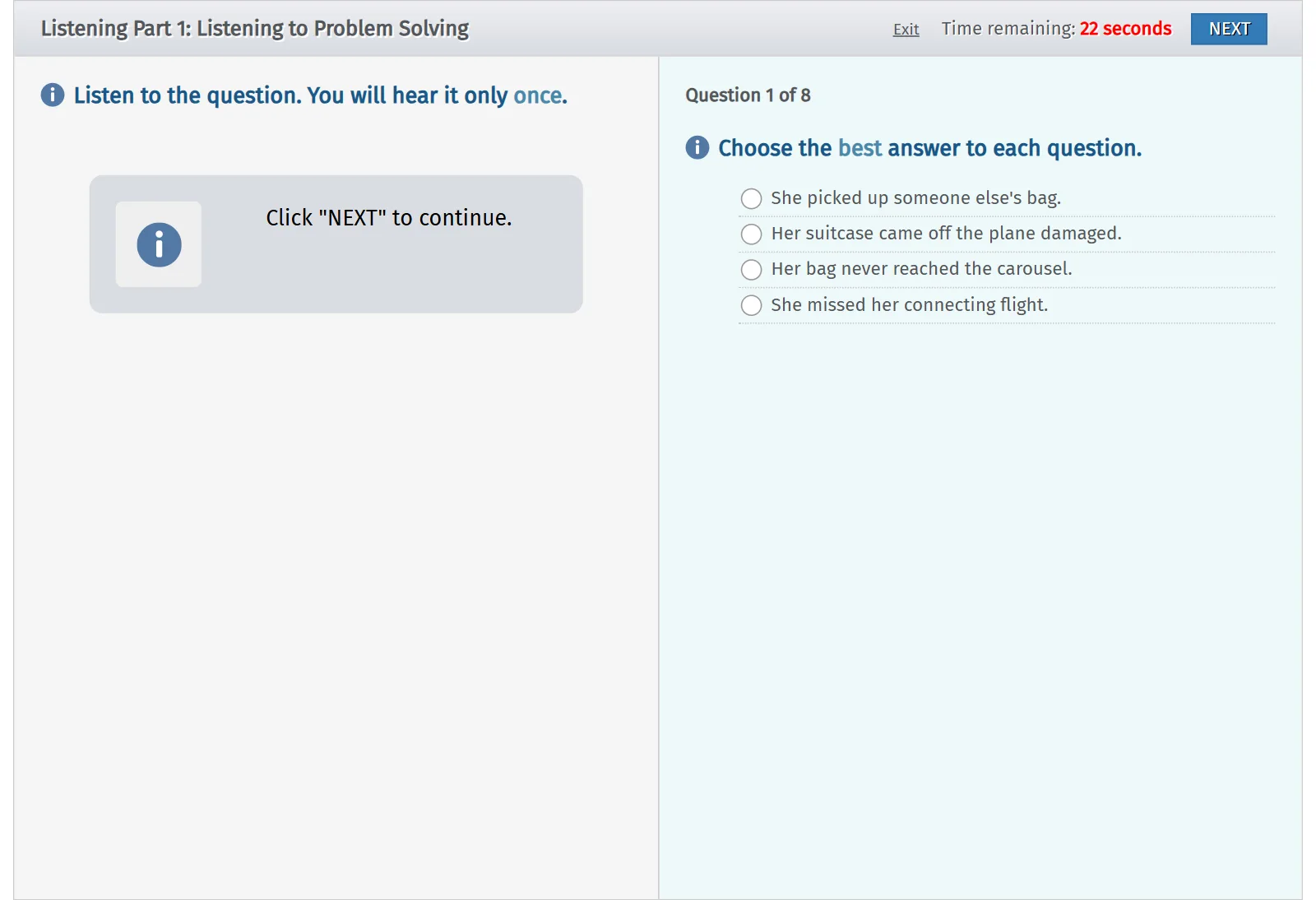
| Part 1: Listening to Problem Solving | A conversation in three sections: one person helps another with a problem | 8 | Spoken questions, one per screen, 30 seconds each |
| Part 2: Listening to a Daily Life Conversation | Two people who know each other talk about something in their lives | 5 | Spoken questions, 30 seconds each |
| Part 3: Listening for Information | One person gets information that they need from another | 6 | Spoken questions, 30 seconds each |
| Part 4: Listening to a News Item | A short news report with one speaker | 5 | Sentence endings in drop-down menus, all on one screen |
| Part 5: Listening to a Discussion | Three people talk through a plan or a problem (a video on the real test) | 8 | Printed questions with drop-down menus, all on one screen |
| Part 6: Listening for Viewpoints | A report that gives several people’s views on one issue | 6 | Sentence endings in drop-down menus, all on one screen |
Each recording plays once. It starts by itself, and you cannot pause or replay it. The questions always come after the recording, so take notes while you listen.
- Parts 1 to 3: you hear each question rather than read it, and you see four answers on the screen. You have 30 seconds for each question. Part 1 can have one question whose four answers are pictures.
- Parts 4 to 6: the questions are printed, and all the questions of the part are on one screen under one clock. You choose each answer from a drop-down menu.
The parts get harder from Part 1 to Part 6. In Part 5, the real test plays a video of three people; Prepiva’s mock test shows still pictures of the speakers, so every question can be answered from what you hear. Read the CELPIP Listening guide for each part with strategies.
Reading: 4 parts, 38 questions
| Part | What you read | Questions | Time |
|---|---|---|---|
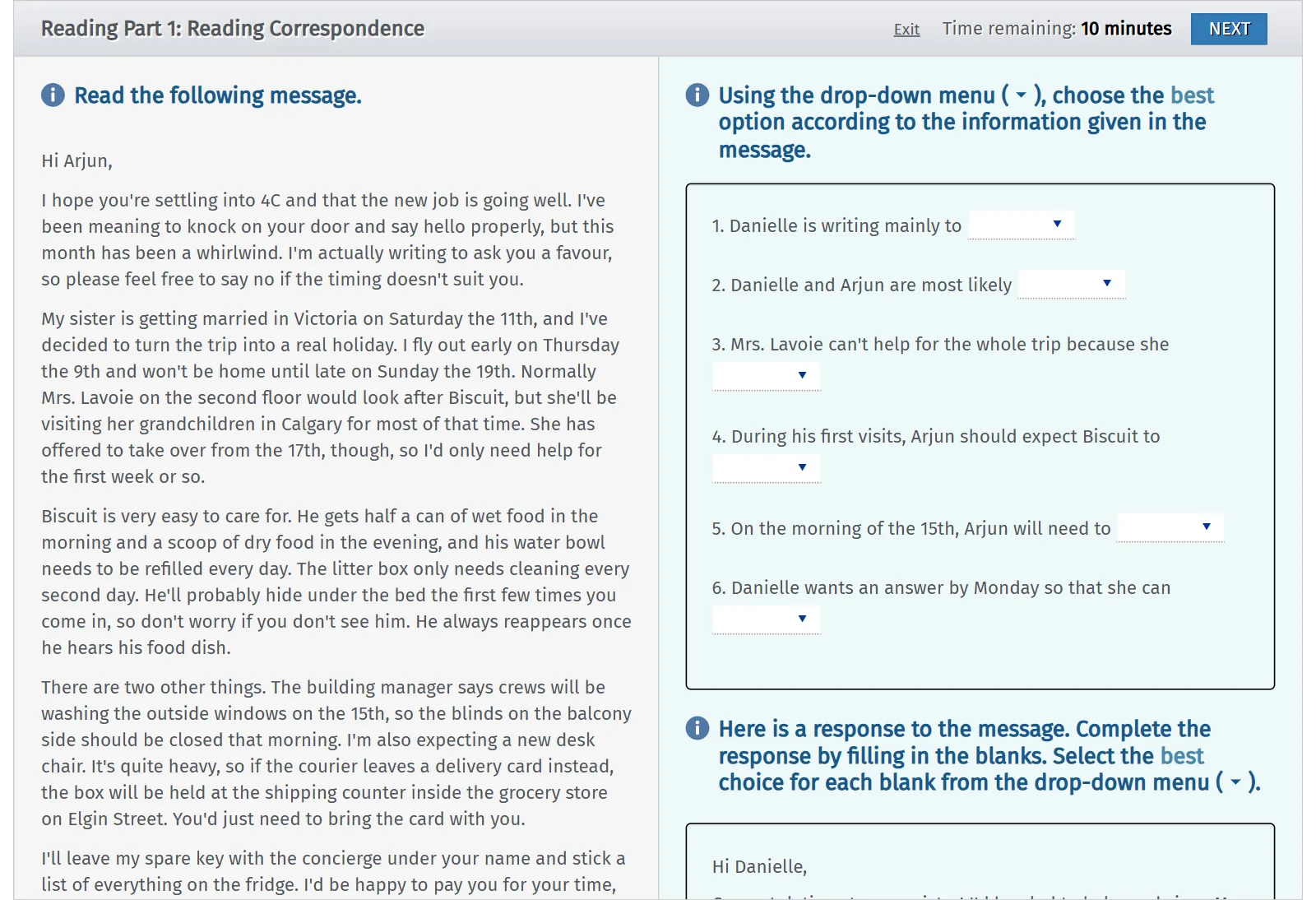
| Part 1: Reading Correspondence | An email, then a reply to it with five blanks | 11 | 11 minutes |
| Part 2: Reading to Apply a Diagram | A diagram that compares four options, then an email with five blanks to fill from it | 8 | 9 minutes |
| Part 3: Reading for Information | Four paragraphs, A to D, and nine statements to match with a paragraph, or with E when the information is not given | 9 | 10 minutes |
| Part 4: Reading for Viewpoints | An article that sets out two or more views, then a reader’s comment with five blanks | 10 | 13 minutes |
Each part is one screen: the text on the left, the questions on the right and one clock for the whole part, 43 minutes across the four parts. You choose every answer from a drop-down menu. When a part’s clock runs out, or when you move on, the part ends and you cannot go back to it.
Part 2 is the one that surprises people. The diagram might compare four classes, four phone plans or four apartments, each with a picture and a few facts, and the email’s blanks only make sense when you combine what the email says with the diagram. The parts get harder from Part 1 to Part 4. See the CELPIP Reading guide for sample questions.
Writing: 2 tasks, 53 minutes
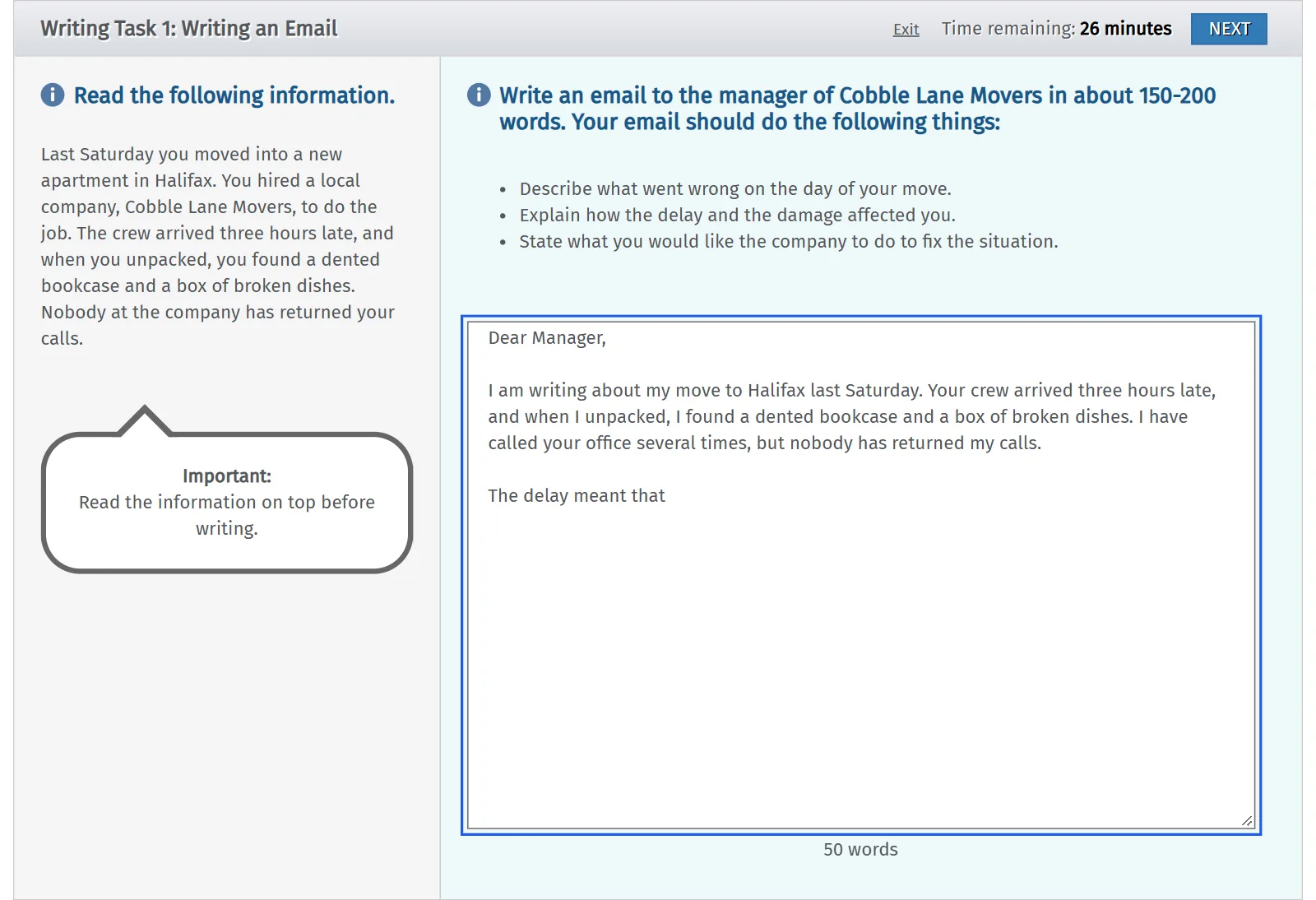
- Task 1, Writing an Email (27 minutes): you read about a situation and write an email of about 150 to 200 words that covers three points. The reader can be a friend, a neighbour, a manager or a company, so the right tone changes from task to task.
- Task 2, Responding to Survey Questions (26 minutes): you read about a decision, choose one of two options and explain your choice in about 150 to 200 words.
Each task has its own clock and ends when the time is up. Plan for a minute or two, write, and keep a few minutes to read your text again. Prepiva’s screen counts your words as you type.
Raters score each response on four dimensions: Content/Coherence, Vocabulary, Readability and Task Fulfillment. Read the CELPIP Writing guide for both tasks.
Speaking: 8 tasks, about 15 minutes
| Task | Preparation | Speaking |
|---|---|---|
| Task 1: Giving Advice | 30 seconds | 90 seconds |
| Task 2: Talking about a Personal Experience | 30 seconds | 60 seconds |
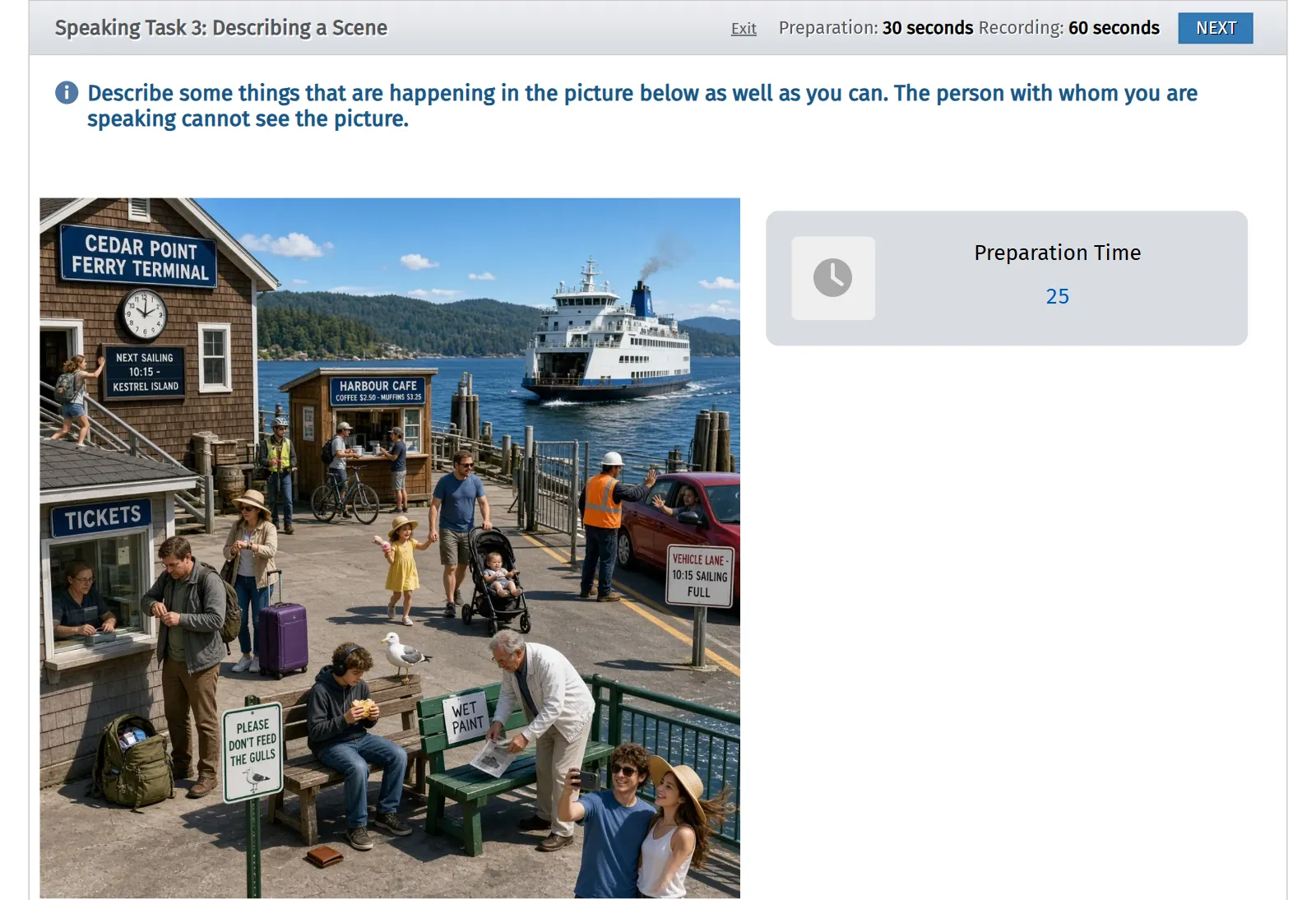
| Task 3: Describing a Scene | 30 seconds | 60 seconds |
| Task 4: Making Predictions (the same picture as Task 3) | 30 seconds | 60 seconds |
| Task 5: Comparing and Persuading | 60 seconds to choose, then 60 seconds | 60 seconds |
| Task 6: Dealing with a Difficult Situation | 60 seconds | 60 seconds |
| Task 7: Expressing Opinions | 30 seconds | 90 seconds |
| Task 8: Describing an Unusual Situation | 30 seconds | 60 seconds |
Each task shows its prompt and counts down the preparation time. Then the computer starts recording for the speaking time and moves on by itself. You cannot record an answer again, so if you make a mistake, correct yourself and keep going.
Task 5 has two steps: you first have 60 seconds to choose between two options, then a third option appears that someone else prefers, and you have 60 seconds to prepare and 60 seconds to persuade them. Tasks 3 and 4 use the same picture: first you describe the scene, then you say what will probably happen next.
Raters score each response on four dimensions: Content/Coherence, Vocabulary, Listenability and Task Fulfillment. Read the CELPIP Speaking guide for every task.
CELPIP-General LS
CELPIP-General LS has only the Listening and Speaking components, with the same parts and tasks as CELPIP-General, and takes about 1 hour 10 minutes. IRCC accepts it for citizenship, where adults aged 18 to 54 need CLB 4 in Listening and Speaking.
For permanent residence through Express Entry and for the post-graduation work permit, IRCC asks for CELPIP-General, with all four skills. If you may need both, take CELPIP-General: IRCC accepts it for citizenship too. To practise for the LS test, take the CELPIP-General LS practice test.
On test day
For IRCC applications, you take the test in person at a test centre. The centre gives you a pen and paper for notes, which you hand back at the end; you cannot bring your own. Other people may be speaking or typing in the same room, so practise with that in mind.
Your scores are online in your CELPIP account 2 to 4 business days after the test. Check ID rules, fees and dates on celpip.ca before you book.
The best preparation for the format is a timed run through it: try the format in a free mock test, and see what your levels mean on the CELPIP score chart.
No account or card to start. Free account to see your report.
FAQ
How long is the CELPIP test?
About 3 hours, in one sitting. Paragon gives Listening 46 to 55 minutes, Reading 43 to 56, Writing 53 and Speaking about 15.
What is the CELPIP exam pattern?
Four components in a fixed order: Listening (6 parts, 38 scored questions), Reading (4 parts, 38 scored questions), Writing (2 tasks) and Speaking (8 tasks), all on a computer in about 3 hours.
How many questions are in CELPIP Listening and Reading?
38 scored questions in each. The test may also contain unscored questions that look the same as the others, so answer every question as if it counts.
Can I go back to an earlier part of the test?
No. A part ends when its clock runs out or when you move on, and you cannot return to it. In Reading, all the questions of a part are on one screen, so you can change your answers until that part ends.
Is there an examiner in the CELPIP Speaking test?
No. You speak into a microphone, and the computer records each answer. Trained raters score the recordings later.
What is the difference between CELPIP-General and CELPIP-General LS?
CELPIP-General tests all four skills and is accepted for permanent residence, the post-graduation work permit and citizenship. CELPIP-General LS tests only Listening and Speaking, takes about 1 hour 10 minutes and is accepted for citizenship.
More on CELPIP
- Free CELPIP practice testTake a free full CELPIP-General mock test in the test's order and timing. Get a level and CLB for each skill, CRS points and AI-rated Writing and Speaking.
- CELPIP ListeningHow CELPIP Listening works: the six parts from problem solving to viewpoints, 38 questions, timing, note-taking and a sample question with the answer explained.
- CELPIP ReadingCELPIP Reading part by part: correspondence, diagrams, information and viewpoints, 38 scored questions, the time per part, sample questions and strategies.
- CELPIP vs IELTSCELPIP-General or IELTS General Training for Canada: format, accents, timing, scoring, CLB conversion, fees and results time, and how to choose between them.